Anticipate critical periods
Identify hours when predicted peak odor concentrations may exceed a site-specific threshold at one or more receptors.


Enviroware × Ambiente et Odora · cloud odor forecasting
PrOlor predicts odor threshold exceedances at sensitive receptors up to 24–48 hours ahead, then sends clear alerts to the people who need to act. No local software. No dashboard to remember to check.

Collaboration
PrOlor combines Enviroware's atmospheric-modeling expertise with the odor-management experience of Ambiente et Odora. Read the project description on olores.org.
Operational value
The calculation system remains rigorous behind the scenes. Operators receive only the information needed to plan work, reduce avoidable exposure, and respond consistently.
Identify hours when predicted peak odor concentrations may exceed a site-specific threshold at one or more receptors.
Reschedule or modify odor-generating activities when the facility has operational measures available to reduce emissions.
Send concise email messages automatically instead of asking multiple users to interpret a technical platform every day.
Configure recipients differently for threshold exceedances, routine forecasts, and non-critical results.
Cloud execution avoids user-installed software, physical modeling servers, hardware obsolescence, and routine platform access.
Use PrOlor continuously, for a defined operational period, or as a short campaign supporting monitoring and sampling decisions.
Automated workflow
After initial site configuration, each forecasting session runs automatically in the cloud. The service can be scheduled up to four times per day.
The final product
PrOlor replaces a daily technical-platform ritual with direct communication. Message content and recipient lists are configured for the facility’s own response procedure.
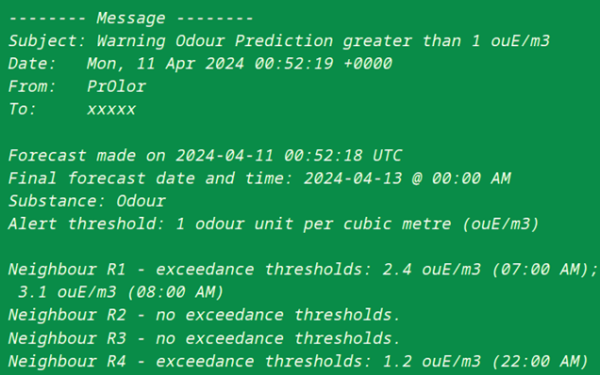
The message identifies the forecast session and reports the receptor, hour, and predicted concentration whenever the selected level of concern is exceeded.
Modeling technology
NCEP’s Global Forecast System supplies initial and boundary conditions for the weather forecast.
WRF uses three nested domains by default—typically 27, 9, and 3 km—with an optional 1 km domain for complex settings.
CALWRF transforms WRF output into the four-dimensional meteorological input required by CALMET.
CALMET produces three-dimensional hourly meteorology, commonly at 250 m horizontal resolution or finer for PrOlor.
The Lagrangian puff model represents multiple source types under spatially and temporally varying meteorological conditions.
Automated postprocessing derives peak concentrations, checks the selected threshold, and prepares the notification.
Site configuration
A one-time setup creates the domains and model files. Source behavior and operational rules are then represented with the level of detail needed for useful forecasts.
Center, extent, terrain, land cover, grid resolution, nesting, and forecast horizon.
Point, area, and volume geometry, odor emission rates, schedules, and scenarios.
Homes, workplaces, public spaces, monitoring sites, and other locations of interest.
Thresholds, peak treatment, recipients, run times, and site-specific response instructions.
Applications
PrOlor is most useful when a facility can alter timing, intensity, controls, or work practices in response to unfavorable dispersion conditions.
Plan windrow turning, material handling, receiving, maturation, and other potentially high-emission activities.
Schedule cleaning, emptying, maintenance, sludge handling, and intermittent operations around lower-risk periods.
Support decisions on process timing, loading, maintenance, temporary controls, and production scenarios.
Plan demolition, excavation, contaminated-soil handling, and other short-duration odor-generating work.
Use short-term forecasts to select instrument deployment, field inspection, or sampling periods and locations.
Combine forecasts with a defined response plan to reduce avoidable exposure and support consistent internal communication.
Validation and evidence
Validation is designed for the deployed configuration and available observations, examining both meteorological performance and whether modeled odor patterns correspond with independent evidence.
Read the peer-reviewed paper or view the conference material describing the system architecture, automated workflow, and alert strategy.
Read the paper ↗Enviroware also supports source characterization, impact assessment, complaint investigation, model review, monitoring design, and mitigation evaluation.
Explore odor services →Project-specific configuration: forecast horizon, run frequency, domain resolution, threshold, peak-to-mean factor, source scenarios, and notification rules are selected for each deployment. PrOlor predictions support operational decisions but do not replace permit conditions, required monitoring, or professional judgment.
Proactive odor management
We will help define the sources, receptors, forecast configuration, alert level, recipients, and response procedure needed for a useful deployment.